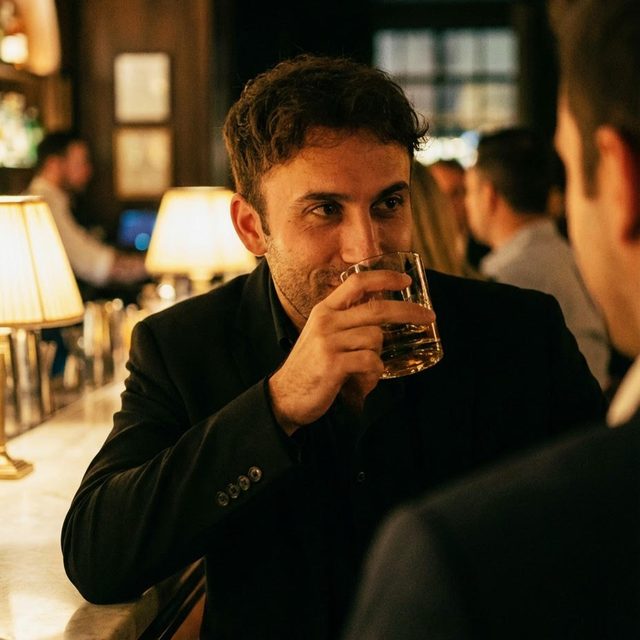
I was lonely and I was stuck, the same week on repeat. So I signed up for 200 hours of something I had never tried.
That was 2019. Six years later there's a group on the sand at Charles Clore every Friday and Saturday, a studio for when it rains, and a morning crew in my garden. This is the whole story, written for the people who moved to this country and discovered that everyone here already has their friends.
Friday, 15:30, Charles Clore. We set up along the edge of the grass, wherever the shade has landed that week, because nobody learns anything standing in the July sun. Shoes come off. Six to twelve people, half of them holding a phone like a shield, because they came alone and nobody has told them what happens next.
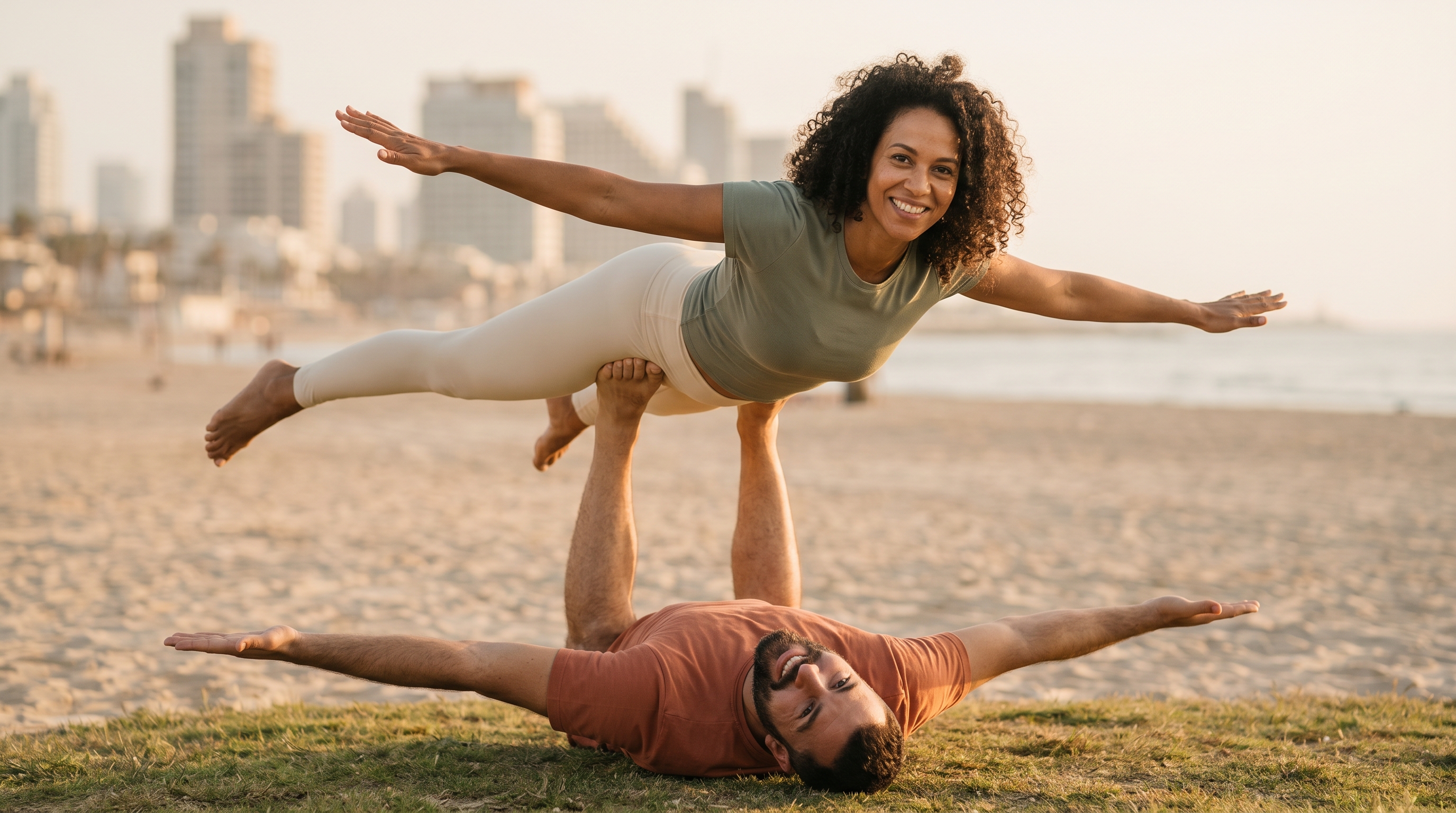
Ten minutes later one of them is flat on her back with her feet in the air, and a person she met at 15:31 is balanced above her, arms out, laughing the way people laugh the first time. Someone stands at the side, hands hovering, ready to catch. Nobody has asked anybody what they do for a living.
It took me years to say this out loud, so I'll say it early. The balancing is the smallest part of it. This is one of the few places left in adult life where two strangers get a real reason to trust each other inside ten minutes, on purpose.
What acroyoga is, before you go and Google it
If you've never seen it: two people move together. One lies down and makes a stable base, usually holding the other up on their feet. The second balances above, the flyer. Somebody spots from the side, hands close enough to catch before you know you're falling. Then you swap.
On Instagram it looks like circus, which is why half the people reading this have decided they can't do it. In practice you start on the ground, hips barely higher than the base's knees, and you stay there until it's almost boring. Boring is the curriculum.
One rule runs the whole thing. When anyone says "down", they go down, immediately, before the shape is finished. New people hear that in the first two minutes, and I've watched it change faces, because most of us aren't used to being told in advance that we can stop.
Just so we're clear: this is a physical movement class. It is not therapy and it is not a healing practice, and I am not going to tell you what it does to your nervous system.
Why I started, which is not a flattering story
2019. I was lonely and I was stuck, and I want to be accurate about that, because those usually get told as two separate stories. For me it was one state. The calendar was full and the Fridays were empty, and every week arrived as a copy of the one before it. Nothing dramatic happened, which in some ways is worse, because there was nothing to point at.
So I did the least casual thing available. I signed up for a full 200-hour acroyoga teacher training, having practised acroyoga exactly zero times. Ridiculous way to start a hobby. It also made it impossible to quietly disappear after week two, which was most of the appeal.
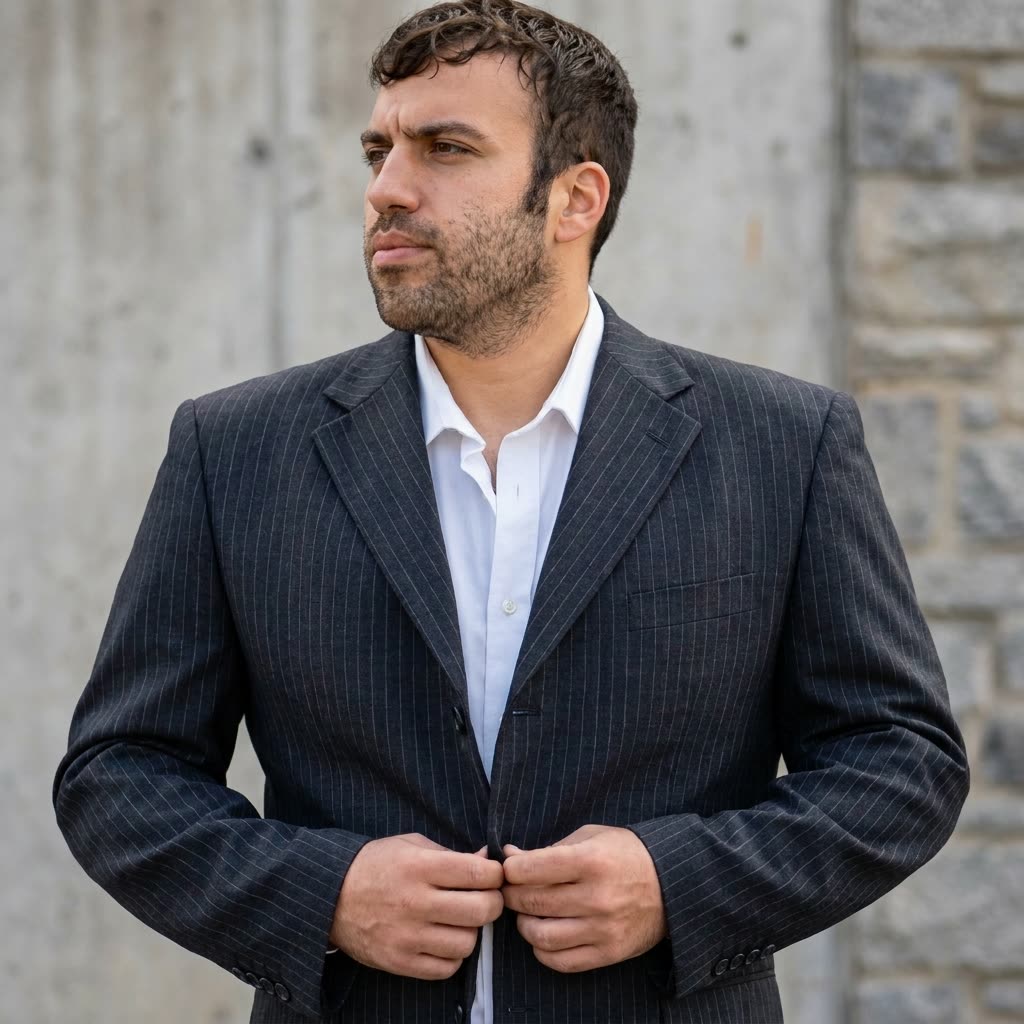
This is where a column like this turns into a résumé and you start scrolling, so I'll be quick. I played competitive college tennis at Nassau Community College and we reached nationals. At UNC Chapel Hill I played club tennis alongside my degree, and I represented my AEPi fraternity chapter at a national competition that had nothing to do with sport, so don't picture a court. I'm a Wingate Institute certified coach. Two tennis books in English on Amazon, one for beginners, one on match strategy.
None of it helped. Being good at a sport and knowing how to walk into a room full of strangers are unrelated skills, and in 2019 I only had the first one. I have a lot of patience for how this feels from the outside, and that's where it comes from.
The poses are the excuse. What brings people back is that for ninety minutes, somebody's actual job is to catch them.
Six years later: a beach, a studio and a garden
The first group I ever ran was in Park HaYarkon. I brought a mat, told a few people a time, and waited to see if anyone would come.
Today it looks like this. Friday and Saturday at 15:30 we meet at Charles Clore, in the shade, for an hour and a half. When it rains we move to the studio on Rokach 40. A morning crew trains in my garden in Hod HaSharon, exactly as unglamorous and as good as that sounds. Twenty is the hard ceiling. When a session hits twenty I close it, which costs me money every month and is the reason the thing still works.
Six years, zero injuries. I keep that number the way other people keep a trophy. It's also why I'm tedious about spotting, and why people who want to skip the basics tend not to love me. On Google we're at 4.9 from 87 reviews, most of them in Hebrew. Here are two, untouched.
"מורה מצויין!! מקצועי, יסודי, קשוב ואיכפתי! ממליץ בחום. עושים יציאות עם מתאמנים אחרים יש אווירה כיפית."
"השיעור היה מעולה, מאוד מקצועי ונעים! שי מאוד מקפיד על בטיחות, וטכניקה נכונה, בקלות יכול לתקנן ולהסביר את התרגיל מומלץ בחום"
Real Google reviews, in Hebrew. The English underneath is my own translation.
I've taught and trained at festivals in Sweden, Italy, Poland and Spain, run retreats in South America, and studied under Lux of SeattleAcro. I list it for one reason: it buys me the right to be this rigid about one small word.
Come to one Friday, in English, on the grass
The community page has the times, the exact spot on the grass, and what happens in a first session. Most people turn up on their own, and nobody needs your Hebrew to be good.
See how it works →The part nobody warns you about when you move here
Most Israelis finished assembling their social life before they turned 22. School, then the army, then a lot of the same faces again at university. By the time you land, those groups are sealed. What you're up against is fifteen years of shared history you weren't in.
The loneliness that follows is structural, and it lands on charming people with excellent Hebrew just as hard as on anybody else. "Put yourself out there" ignores the part where everyone is lovely to you all evening and then goes home to their own people.
I never made aliyah. What I know is the version one door over: I came back to Tel Aviv after years abroad and started from zero in a city I had always technically belonged to. Being surrounded by your own language with nobody to call on a Friday is a strange, quiet thing.
Friendship runs on hours, and the hours have to repeat. School and the army hand them over whether you asked or not. Somewhere after that the supply quietly stops, nobody sends a letter about it, and most people conclude the problem is them. From then on you have to put the repetition on a calendar like a dentist appointment, which sounds bleak and works anyway.
Two answers to what lands in my inbox every week. Yes, it runs in English. I lived in the States, I coach in English, and the working vocabulary in acro is about ten words long: bend, straighten, look at me, breathe, down. And yes, almost everybody arrives alone. That is simply how the group fills. You get paired with one or two people in the first minutes, before anyone can stand at the edge of the grass feeling like the new kid.
What I won't tell you is that this integrates you into Israeli society. It doesn't. It's a movement class. What it gives you is a recurring Friday with the same faces, and after a few months some of those faces text you about things that have nothing to do with acroyoga. That's the real product. People send me research about touch and connection. It's interesting. I'm not borrowing somebody else's findings to sell a class on the sand.
If you'd rather build your own, take mine
Some of you are reading this from Haifa, from Be'er Sheva, from a moshav where nobody runs anything. What you need is your own group, on your own street. So here's everything I know about the format, free.
How to build a group people actually come back to
- Pick one hour and never move it. Mine has been 15:30 for six years. A group that floats around the calendar is a group people forget.
- Cap it, and mean it. Six to twelve is where people still learn each other's names. I close at twenty even when it costs me, because twenty-one people standing in a circle is an audience.
- Pair people in the first two minutes. Before anyone settles into standing alone. Do it yourself, out loud.
- Give everyone a word that stops everything. Ours is "down", instantly, no questions. Whatever your activity, people relax once they know they hold the brake.
- Start lower than feels interesting. The first thing you do together should be almost too easy. People walk out of an easy first session feeling capable, and capable people come back.
Back at the beach the class is over, the shade has crawled sideways, and the phones that came in as shields are back in bags. Most weeks a few of the people who arrived alone are still sitting on the sand afterwards, arguing about where to eat.
Nobody planned that. It's what a fixed hour does, week after week, once people are certain they're allowed to say down.
One Friday. Bring nobody.
Charles Clore, 15:30, ninety minutes in the shade, Rokach 40 if it rains. You'll be paired with someone within a couple of minutes, you'll start on the ground, and if you want down, you say down.
See how it works →Sources
- Google rating and review count (4.9 from 87 reviews), and the two quoted reviews by David Fattal and Daria Zaks, from the public Google profile. English glosses are my own translations. Read the reviews on Google
- Member count: distinct paying members in the trailing 35-day billing cycle, read off the billing system on 30 July 2026.
- The tennis books on Amazon: Tennis Bible · Mastering the Tennis Match
- Coaching certification: Wingate Institute, Israel's national institute for sport and physical education. Acroyoga: 200-hour teacher training, 2019, and continued study under Lux of SeattleAcro.